
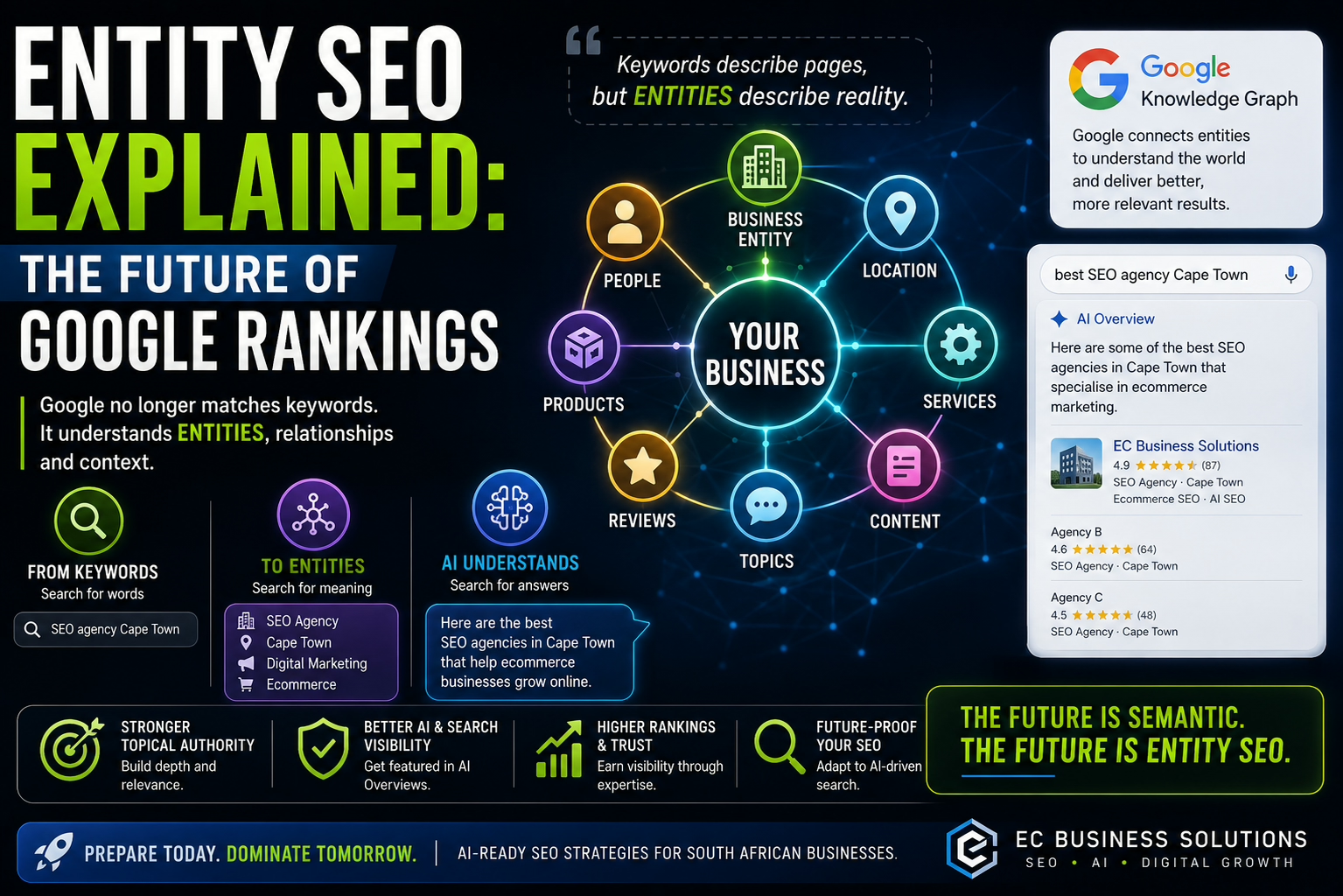
Entity SEO Explained: The Future of Google Rankings
A user searches:
“best SEO agency for ecommerce businesses in Cape Town.”
Ten years ago, Google primarily matched those words against indexed webpages.
Today, search works very differently.
Modern search engines increasingly attempt to understand:
- what the user actually means,
- what kind of business they are looking for,
- what relationships exist between services,
- which companies demonstrate expertise,
- and which entities are contextually trustworthy.
Google is evolving from a search engine into a knowledge engine.
Instead of simply finding pages with matching keywords, it increasingly tries to understand:
- businesses,
- products,
- industries,
- locations,
- services,
- and relationships between them.
This is the foundation of Entity SEO.
Many businesses still optimise websites primarily around:
- keyword density,
- exact-match phrases,
- and isolated landing pages.
Meanwhile, modern search increasingly revolves around:
- semantic understanding,
- contextual meaning,
- topical authority,
- and machine-readable relationships.
Keywords describe pages.
Entities describe reality.
This shift is becoming one of the most important developments in:
- AI SEO South Africa,
- semantic SEO,
- and future search visibility.
Businesses that understand Entity SEO early will gain a significant competitive advantage as AI-driven search systems continue evolving.
What Is Entity SEO?
Entity SEO is the process of helping search engines understand:
- what your business is,
- what you specialise in,
- how your content relates together,
- and where you fit within a larger knowledge ecosystem.
Keywords vs Entities
Traditional SEO focused heavily on keywords.
For example:
- “SEO company Cape Town”
- “digital marketing agency”
- “web design South Africa”
Search engines mainly looked for pages containing those phrases.
Entity SEO works differently.
An entity is a recognised concept or object.
Examples of entities include:
- businesses,
- locations,
- products,
- people,
- services,
- industries,
- and brands.
For example:
A business may be recognised by Google as:
- a digital marketing agency,
- located in South Africa,
- specialising in SEO,
- connected to ecommerce marketing,
- associated with technical SEO,
- and relevant to local businesses.
This creates semantic understanding.
Search Engines Understand Relationships
Modern search systems increasingly evaluate relationships between entities.
For example:
Google may connect:
- SEO,
- ecommerce,
- website speed,
- AI search,
- and local business visibility,
as related concepts.
This allows search engines to interpret meaning more intelligently.
Context Matters More Than Ever
A webpage no longer ranks simply because it repeats a keyword many times.
Search systems increasingly evaluate:
- expertise,
- contextual relevance,
- semantic consistency,
- and topical authority.
Entity SEO strengthens all of these signals.
How Google Search Has Changed
Google search today is dramatically different from the search engine many businesses optimised for a decade ago.
Traditional Keyword SEO
Older SEO strategies focused heavily on:
- exact-match keywords,
- backlinks,
- metadata,
- and keyword repetition.
These tactics still matter to some degree.
But modern search systems are becoming far more contextual.
Semantic Search
Semantic search focuses on:
- meaning,
- relationships,
- user intent,
- and contextual understanding.
Google increasingly attempts to understand:
- why users search,
- what they want,
- and which entities best satisfy that intent.
AI Search Systems
AI-driven search systems now influence how search results are generated.
This includes:
- Google AI Overviews,
- conversational search,
- contextual retrieval,
- and AI-generated answers.
Search engines increasingly summarise information rather than simply listing websites.
Conversational Search Is Growing
Users increasingly search using natural language.
For example:
- “Which SEO strategy works best for small businesses?”
- “How can I improve my Google rankings?”
- “What is semantic SEO?”
Search engines increasingly interpret full contextual meaning instead of isolated phrases.
Topical Authority Matters More
Google increasingly rewards websites demonstrating:
- expertise,
- authority,
- semantic depth,
- and contextual consistency.
Thin keyword-focused pages are becoming less effective over time.
Why Entity SEO Matters for South African Businesses
Many South African businesses still rely on outdated SEO strategies.
This creates a major opportunity for early adopters.
Most Local Websites Are Still Keyword-Focused
A large number of SMEs still optimise websites primarily around:
- basic keywords,
- isolated landing pages,
- and generic service descriptions.
Very few focus on:
- semantic relationships,
- structured data,
- entity consistency,
- or machine-readable content.
AI SEO South Africa Is Still Emerging
Compared to international markets, AI SEO South Africa remains relatively underdeveloped.
This creates a valuable advantage for businesses willing to invest early in:
- semantic SEO,
- Entity SEO,
- technical SEO,
- and AI-ready websites.
Local Authority Is Becoming More Important
Search engines increasingly evaluate:
- business credibility,
- location relevance,
- reviews,
- topical expertise,
- and contextual trust.
Businesses with stronger entity signals gain visibility advantages.
Ecommerce Visibility Depends on Semantic Clarity
Ecommerce businesses increasingly compete inside:
- AI-generated recommendations,
- semantic product searches,
- and contextual retrieval systems.
Structured product relationships matter more than ever.
Google’s Knowledge Graph Explained
One of the most important systems behind modern search is Google’s Knowledge Graph.
What Is the Knowledge Graph?
The Knowledge Graph is Google’s system for understanding:
- entities,
- relationships,
- concepts,
- and contextual associations.
Instead of simply indexing pages, Google increasingly builds interconnected maps of information.
Businesses Become Recognised Entities
Google increasingly attempts to identify:
- what your business is,
- what services you offer,
- where you operate,
- who your competitors are,
- and how your business relates to other entities.
This is why consistency matters across:
- websites,
- Google Business Profiles,
- social platforms,
- citations,
- and structured data.
Relationships Influence Visibility
Search engines increasingly evaluate:
- how pages connect,
- how services relate,
- how content clusters together,
- and how authority flows through websites.
Disconnected content weakens semantic understanding.
Reviews and Trust Signals Matter
Google also evaluates:
- customer reviews,
- authority mentions,
- brand consistency,
- and trust signals,
as part of entity understanding.
Entity SEO overlaps heavily with digital trust.
Semantic SEO and AI Search
Semantic SEO is becoming foundational to future search visibility.
What Is Semantic Search?
Semantic search focuses on:
- meaning,
- context,
- relationships,
- and user intent.
Search systems increasingly interpret:
- topics,
- concepts,
- and contextual relationships,
rather than simply matching words.
AI Search Optimisation
AI systems increasingly favour websites that are:
- semantically organised,
- technically structured,
- authoritative,
- and contextually clear.
This is why AI-ready SEO is becoming increasingly important.
Machine-Readable Content Matters
Search systems increasingly rely on:
- structured information,
- semantic hierarchy,
- internal linking,
- and contextual clarity.
Messy websites create semantic confusion.
AI Overviews Are Changing Visibility
Google AI Overviews increasingly summarise:
- answers,
- comparisons,
- recommendations,
- and explanations,
directly within search results.
Businesses now compete for inclusion within AI-generated summaries.
Retrieval-Based Search Is Growing
Future search increasingly works through:
- retrieval,
- contextual understanding,
- semantic matching,
- and entity relationships.
Entity SEO helps businesses become more understandable to AI systems.
Practical Entity SEO Strategies for SMEs
The good news is that SMEs can begin improving Entity SEO without massive budgets.
Improve Service Page Clarity
Service pages should clearly explain:
- what the business offers,
- who it serves,
- where it operates,
- and what expertise it provides.
Clarity improves semantic understanding.
Create Topical Content Clusters
Instead of publishing random blog posts, businesses should build content around:
- core services,
- industry expertise,
- and customer pain points.
This strengthens topical authority.
Implement Schema Markup
Schema markup helps search engines understand:
- businesses,
- services,
- locations,
- reviews,
- FAQs,
- and products.
Structured data improves machine understanding.
Strengthen Internal Linking
Internal links help search systems understand:
- hierarchy,
- contextual relationships,
- and topic relevance.
Semantic linking matters.
Optimise Google Business Profiles
Google Business Profiles strongly influence:
- local entity recognition,
- trust signals,
- and local SEO visibility.
Consistency is critical.
Use FAQ Sections
FAQs help reinforce:
- semantic relevance,
- user intent,
- and contextual clarity.
They also align well with conversational search behaviour.
Structured Data and Machine-Readable Websites
Structured data is becoming essential for modern SEO.
What Is Structured Data?
Structured data is code that helps search engines interpret:
- businesses,
- services,
- products,
- locations,
- and content relationships.
Schema Markup Improves Understanding
Schema helps Google understand:
- business identity,
- reviews,
- service areas,
- FAQs,
- and contextual information.
This strengthens entity recognition.
Business Schema
Business schema helps define:
- company details,
- contact information,
- locations,
- and services.
FAQ Schema
FAQ schema reinforces:
- question-and-answer relationships,
- contextual relevance,
- and semantic understanding.
Product Schema
Ecommerce businesses benefit heavily from:
- product schema,
- review schema,
- and pricing information.
Structured Data Is Communication Infrastructure
Structured data functions as communication infrastructure for AI systems.
It helps machines interpret meaning more accurately.
The Future of SEO in South Africa
SEO is entering a major transformation phase.
AI-Driven Search Will Continue Expanding
Search engines increasingly rely on:
- AI-generated answers,
- semantic retrieval,
- and contextual interpretation.
This changes how visibility works online.
Voice Search and Conversational Search Will Grow
Users increasingly interact with search systems conversationally.
Businesses must optimise for:
- questions,
- context,
- and natural language understanding.
Machine-Readable Websites Will Win
Future SEO success increasingly depends on:
- semantic clarity,
- structured content,
- technical quality,
- and machine readability.
Authority Will Matter More
Search engines increasingly reward:
- expertise,
- trust,
- topical depth,
- and semantic consistency.
Generic content becomes less effective over time.
South African SMEs Still Have a Major Opportunity
Most businesses have not adapted yet.
This creates enormous opportunity for SMEs willing to invest early in:
- Entity SEO,
- semantic SEO,
- technical SEO,
- and AI-ready digital strategies.
The businesses that move first will gain significant visibility advantages.
Conclusion
Entity SEO is not replacing traditional SEO.
It is evolving SEO into semantic search optimisation.
Search engines are becoming:
- more contextual,
- more intelligent,
- more AI-driven,
- and more focused on understanding meaning rather than simply matching keywords.
This changes how businesses compete online.
Future search visibility will increasingly depend on:
- authority,
- semantic clarity,
- contextual trust,
- structured data,
- topical expertise,
- and machine-readable websites.
Businesses that continue relying only on outdated keyword strategies risk becoming progressively less visible within AI-driven search environments.
At EC Business Solutions, SEO strategies are built around:
- Entity SEO,
- semantic SEO,
- AI-ready SEO,
- technical SEO,
- local SEO,
- and future-focused search visibility systems.
The future of SEO belongs to businesses that communicate clearly not only to people — but also to search engines and AI systems.
Request an Entity SEO Audit, Semantic SEO Review, Technical SEO Assessment, or AI Search Visibility Analysis to identify where your business may already be losing visibility within the next generation of semantic search.


