
The Architecture of Authority: Why Your Brand Needs a Unified Knowledge Graph
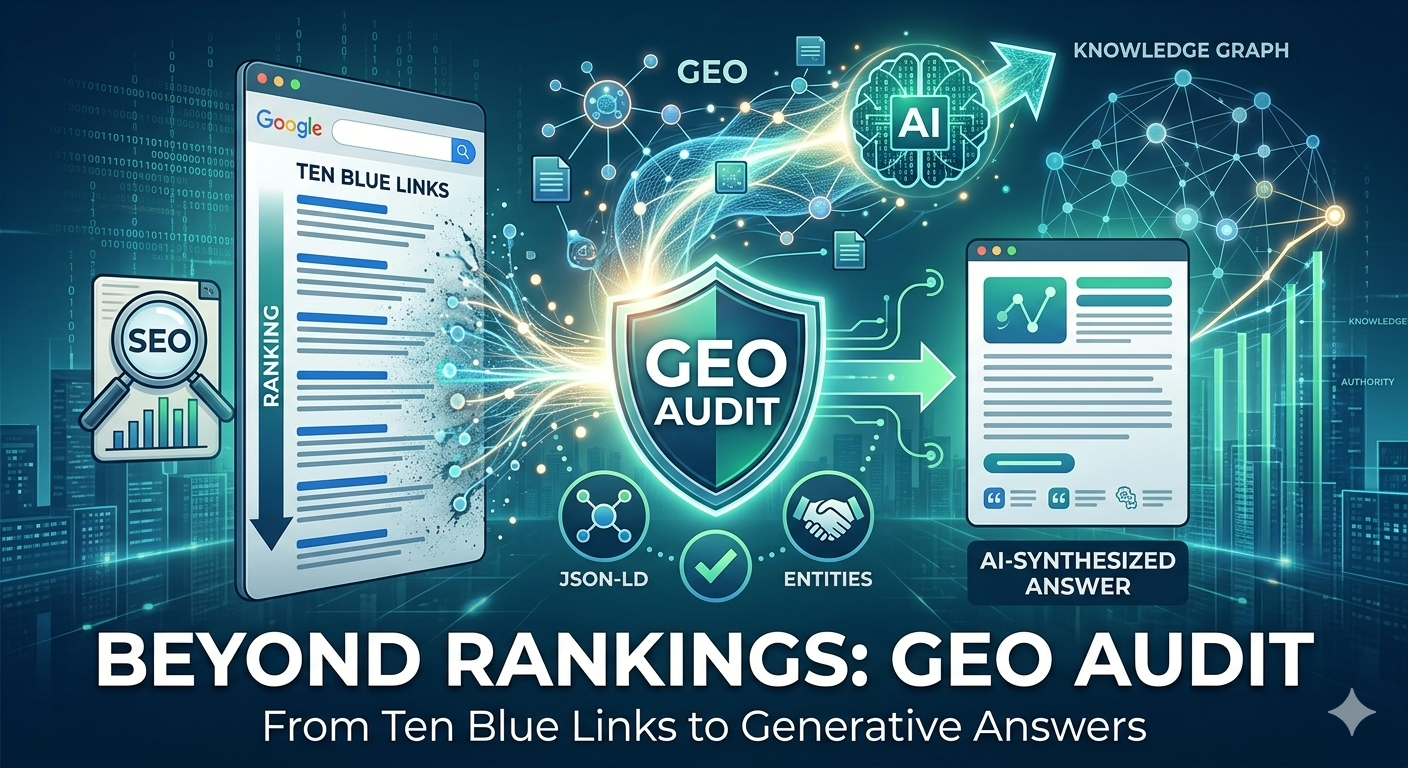
In the era of Generative AI, traditional SEO is no longer the primary determinant of brand visibility. When a user asks Gemini, ChatGPT, or Perplexity a high-stakes question, the AI is not “searching” in the traditional sense; it is synthesizing knowledge.
The question is no longer “How do I rank for these keywords?” but rather: “Does the AI believe your brand is the definitive source of truth?”
To answer that question, you need to move beyond standard web development and embrace the architecture of a Unified Knowledge Graph.
Beyond Pages: The Entity-Based Web
Most websites are built as collections of loosely connected pages. In the eyes of an LLM, this is a disconnected mess.
An entity-based approach changes this. It treats your business as a discrete “node” in a global web of facts. To be recognized as an authority in your field—whether you are in legal, finance, or luxury retail—you must provide the search engine with a map that explicitly links your people, your credentials, your history, and your service assets.
The Coetzee Convergence: Your Digital Passport
At the heart of the Coetzee Convergence Framework lies the construction of a Unified Knowledge Graph. Think of this as a “Digital Passport” for your entire enterprise.
Without a unified knowledge graph, your digital identity is fragmented. Your LinkedIn profile, your website, your professional registry entries, and your client case studies exist in silos. Because they are not cryptographically or semantically linked, AI models assign your brand a lower “confidence score.”
By implementing structured data (JSON-LD) that connects these disparate touchpoints into a single, verifiable identity, we ensure that:
- The AI “Trusts” Your Content: When your site is cited by an LLM, the model has verified your credentials through a clear chain of semantic evidence.
- Contextual Relevance: The AI understands not just what you do, but the context in which you do it—linking your professional history to your specific service outcomes.
- Resilience Against Misinformation: A unified knowledge graph creates a “truth anchor” that makes it significantly harder for AI systems to hallucinate incorrect information about your firm.
Building the Architecture
Constructing a unified knowledge graph is not a “plug-and-play” task. It is a rigorous architectural endeavor:
- Entity Mapping: We define your core business entities (Organization, Person, Service) and map their relationships using a controlled vocabulary.
- Semantic Linkage: We ensure that every piece of content you produce is cross-referenced within your schema, creating a web of proof that spans your entire digital presence.
- Confidence Scoring: We monitor how AI engines ingest your data, refining your structured output to continuously improve your brand’s “confidence score” in generative search queries.
The Professional Pivot: From “Web Pages” to “Verifiable Entity”
At EC Business Solutions, we specialize in the engineering of authority. We do not just build websites; we build the technical infrastructure that allows your business to function as a verified, trusted entity in the age of generative intelligence.
We work with organizations that understand that authority is not something you claim—it is something that must be mathematically proven to the machine.
If you are operating in a high-trust industry, your digital infrastructure should be as robust as your professional reputation. It is time to move past the era of SEO and into the era of Entity Authority.
Is your brand’s digital identity verifiable, or is it just a collection of pages?
[Contact EC Business Solutions today for an Entity Authority Audit.] Let’s build the unified knowledge graph that will position your brand as the definitive authority in your industry.


