
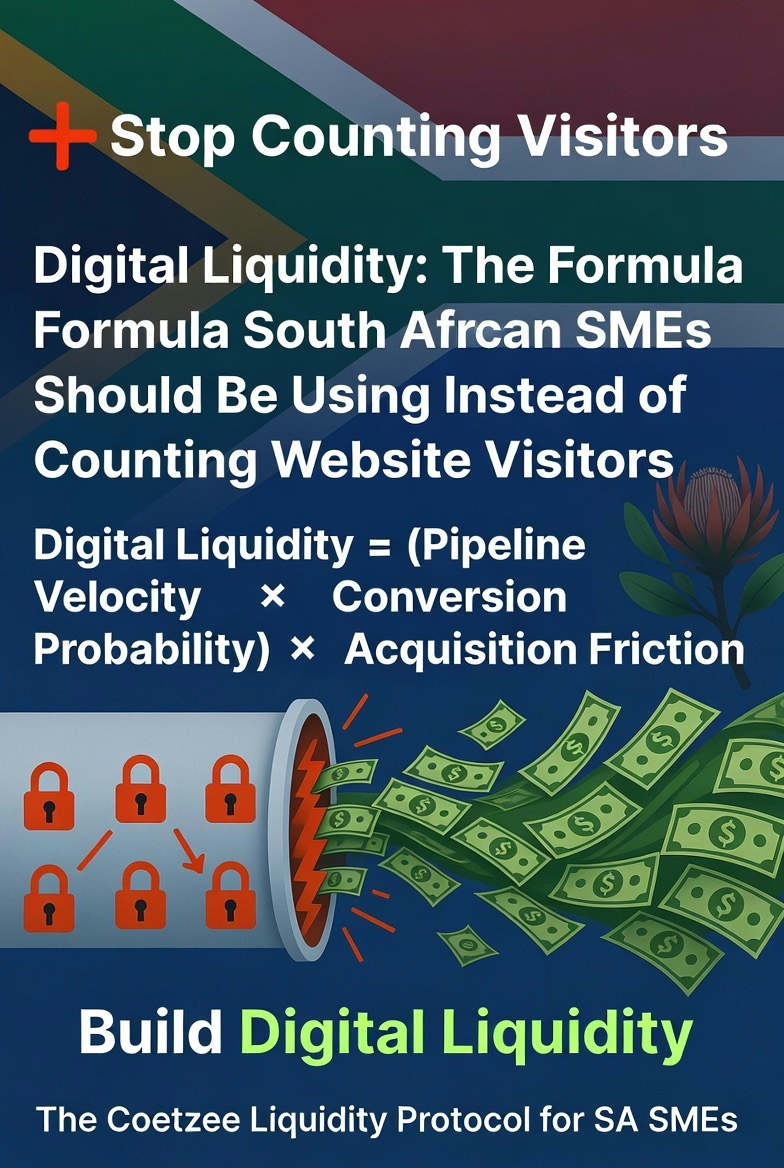
Digital Liquidity: The Formula South African SMEs Should Be Using Instead of Counting Website Visitors
EC BUSINESS SOLUTIONS — RESEARCH PAPER
The Blocked Pipeline: How the Coetzee Liquidity Protocol Diagnoses and Fixes the Digital Conversion Problem Killing South African SME Revenue
Erwee Coetzee | EC Business Solutions
Section 1: Executive Summary
Most South African SME owners who are not getting enough business from their digital presence diagnose the same problem: not enough traffic. The solution they pursue follows from this diagnosis — more Google Ads spend, more social media posts, more SEO keywords, a bigger marketing budget. And in most cases, this solution does not work. Not because traffic is unimportant, but because traffic is not the binding constraint. The binding constraint is what happens to the traffic that already exists: the qualified prospective clients who arrive at the digital presence with genuine intent and leave without making contact, because something in the experience — a missing price, an invisible credential, a broken contact path — interrupted their confidence before they converted.
The Coetzee Liquidity Protocol (CLP) is a diagnostic and deployment framework built around a single governing formula:
Digital Liquidity = (Qualified Pipeline Velocity × Conversion Probability) ÷ Acquisition Friction
The formula measures the rate at which a business’s digital presence converts qualified prospective clients into paying customers. Digital Liquidity is high when qualified prospects arrive consistently, convert at a high rate, and face minimal barriers between intent and first payment. Digital Liquidity is low — and business growth is constrained — when any one of the three variables is outside its target range. The CLP’s diagnostic identifies which variable is the binding constraint, calculates the Asymmetry Cost of that constraint in rand terms, and prescribes the specific architectural intervention that resolves it.
This paper applies the CLP to five South African SME sectors — trades businesses, professional services sole practitioners, retail and e-commerce operators, hospitality and tourism SMEs, and health and wellness practices — diagnosing the dominant friction source in each sector and prescribing the resolution protocol. It closes with a 30-minute self-assessment instrument that any SA SME owner can use to identify their own binding constraint and calculate their Asymmetry Cost. The argument of this paper is precise: the majority of South African SMEs have a blocked pipeline, not an empty one. The CLP is the instrument that locates the blockage, quantifies it, and removes it.
Section 2: The SA SME Pipeline Problem
Misdiagnosing the Constraint
In fourteen years of working with South African SMEs on WordPress hosting and SEO, I have watched the same diagnostic error repeat itself with remarkable consistency. A business owner who is not getting enough enquiries from their website concludes that the website needs more traffic. They invest in Google Ads, or in a social media manager, or in an SEO package that promises first-page rankings. Sometimes the traffic increases. The conversion rate stays the same. The enquiry volume increases marginally, in proportion to the traffic increase, and the return on the marketing investment is disappointing. The business owner concludes that digital marketing does not work for their type of business, and stops investing.
The diagnostic error is the assumption that traffic is the binding constraint. In the majority of SA SME cases I have audited, it is not. The business has adequate qualified traffic for its growth targets — it is getting the right kinds of visitors, in the right numbers, from the right geographic areas. What it is not doing is converting them. And the reason it is not converting them is not a mystery. It is an information asymmetry condition that George Akerlof described with mathematical precision in 1970: the prospective client cannot assess the quality and reliability of the business before engaging with it, and in the absence of that information, their rational response is hesitation or abandonment. The digital presence either resolves that information deficit — with credential signals, pricing frameworks, and evidence of track record — or perpetuates it. Most SA SME websites perpetuate it.
What Digital Liquidity Means for an SA SME
Digital Liquidity, in the CLP’s framework, is the practical answer to a question that every SME owner asks: is my digital presence working hard enough for my business? A highly liquid digital presence generates qualified first contacts consistently, converts them at a high rate, and does so with minimal friction — minimal time, minimal uncertainty, and minimal risk experienced by the prospective client in the journey from first discovery to first payment. A low-liquidity digital presence generates some traffic, converts a fraction of it at a rate that does not justify the hosting and marketing costs, and leaves a substantial portion of its qualified audience unserved — not because they did not want the service, but because the digital experience failed to sustain their confidence through to conversion.
The SEDA 2023 SME report documents a significant digital adoption gap across South African small businesses, with the majority of SME websites functioning as static brochures rather than active conversion assets. This gap is not primarily a technology gap — WordPress is accessible to any business at any budget level. It is an architecture gap: most SA SME websites were built to answer the question “does this business exist?” rather than the question “can I trust this business enough to give them my money?” The CLP addresses this architecture gap by mapping every element of the digital presence to its commercial impact on the three formula variables and sequencing interventions by their return on investment.
The Three SA-Specific Friction Sources
The CLP identifies three dominant Acquisition Friction sources that are endemic to the South African SME market and that account for the majority of the conversion gap between current performance and achievable Digital Liquidity. They are Price Opacity, Credential Invisibility, and Contact Path Confusion. Each is grounded in the Akerlof information asymmetry mechanism. Each is directly addressable through digital architecture without requiring additional traffic. And each has a calculable Asymmetry Cost — the rand value of revenue that the business is failing to capture every month because the friction source is unresolved.
Price Opacity is the condition in which a prospective client cannot determine, from the digital presence, approximately what the service will cost. For service businesses — plumbers, electricians, accountants, physiotherapists, cleaning companies — this is almost universal in the SA market. The reasoning behind it is understandable: prices vary by job scope, travel distance, materials required, and time of day. Publishing a fixed price feels either inaccurate or commercially risky. The consequence, however, is Acquisition Friction at a commercially significant level. A prospective client who cannot estimate cost from the website must make an enquiry step solely to obtain pricing information before they can make a decision. Research on SA consumer behaviour consistently shows that a material proportion of prospective clients — particularly those using mobile search under time pressure — do not take this step. They move to a competitor who has reduced this friction, even if that competitor is more expensive. The CLP’s resolution is not to publish fixed prices. It is to publish a pricing framework: the starting rate, the factors that affect the final price, and the process for obtaining a specific quote. This resolves the information deficit without the commercial risk of fixed pricing.
Credential Invisibility is the condition in which the business’s professional registrations, accreditations, and regulatory compliance records are not visible or verifiable in its digital presence. In the South African professional services and regulated trades context, where professional body registration is both legally required and a primary quality signal for prospective clients, Credential Invisibility is particularly costly. A prospective client who cannot find the plumber’s Master Plumbers’ Association membership number, the accountant’s SAIPA registration, or the electrician’s Certificate of Competence registration on the digital presence cannot verify that the business is legitimately operating in its regulated category. This is the Akerlof lemon condition at its most direct: without verifiable credential signals, the buyer has no mechanism for distinguishing a competent, compliant operator from a non-compliant one, and rational risk aversion suppresses conversion accordingly. The CLP’s resolution encodes these credentials as structured schema entity assertions with URI references to the professional body’s directory — converting invisible credentials into machine-readable, human-verifiable trust nodes.
Contact Path Confusion is the condition in which the business’s digital presence does not provide a clear, low-friction WhatsApp contact path matching the SA mobile buyer’s default conversion behaviour. In South Africa, WhatsApp is not a supplementary communication channel. It is the primary channel through which a large and growing proportion of SME clients — across income levels, geographic areas, age groups, and service categories — prefer to initiate contact with service providers. A business whose website displays a contact form, a landline number, and a generic email address, with no prominent WhatsApp click-to-chat button, is generating Contact Path Confusion against the buyer’s intent. The friction is not cognitive — the buyer knows how to contact the business. The friction is motivational: the contact path the business provides does not match the contact path the buyer prefers, and that mismatch creates enough resistance to suppress a material proportion of first-contact initiations.
The Asymmetry Cost Calculation
The Asymmetry Cost is the CLP’s instrument for converting the three friction sources from qualitative observations into commercial investment cases. It calculates the monthly revenue the business is failing to capture because each friction source is unresolved. The formula is:
Asymmetry Cost (monthly) = Qualified Monthly Visitors × Conversion Rate Gap × Average Transaction Value
Where the Conversion Rate Gap is the difference between the business’s current conversion rate and the benchmark conversion rate for businesses in the same sector that have resolved the friction source in question. Consider a worked example at SA SME scale. A plumber in Mitchells Plain receives approximately 200 qualified website visitors per month — people searching for plumbing services in his geographic area. His current conversion rate, measured as the proportion of those visitors who make a first contact (WhatsApp, call, or form), is 4%: 8 first contacts per month. Of those 8 contacts, he books 4 jobs. His average job value is R1,800. Monthly revenue from digital: R7,200. Industry benchmark conversion rate for plumbers with resolved friction sources (pricing framework published, professional registration visible, WhatsApp click-to-chat prominent): 9%. Applying the benchmark conversion rate to his existing 200 monthly visitors produces 18 first contacts per month, booking 9 jobs (maintaining his current 50% contact-to-booking rate). Monthly revenue at benchmark conversion: R16,200. Monthly Asymmetry Cost: R9,000. Annual Asymmetry Cost: R108,000. The cost of resolving his three friction sources — a half-day of implementation work on his existing website — is a single-digit fraction of this annual revenue loss. This is not a marketing investment. It is a maintenance intervention on revenue that the business has already earned the right to receive.
Section 3: The CLP Formula — Applied to SA SMEs
Qualified Pipeline Velocity
Qualified Pipeline Velocity (Pv) is the rate at which prospective clients who match the business’s service scope, geographic area, and budget range make first contact. The emphasis on “qualified” is commercially critical and frequently misunderstood by SA SME owners who measure their digital performance by website traffic volume. Unqualified traffic — visitors from outside the service area, visitors searching for services the business does not offer, visitors with no current intent to purchase — contributes nothing to Digital Liquidity. It inflates vanity metrics and creates the illusion of digital performance where none exists. Qualified Pipeline Velocity measures only the traffic that matters: prospective clients with a specific, immediate need that the business can serve, who have found the business through digital discovery and taken the first contact step.
In the SA SME context, improving Qualified Pipeline Velocity requires the Structural Clarity interventions of the CCF’s first pillar: a correctly structured, geographically specific entity graph that produces high retrieval confidence for the specific local queries that the business’s target clients produce. This is the domain specificity argument from the growth hacking paper — the plumber in Mitchells Plain who structures his entity graph to explicitly assert emergency plumbing services in Mitchells Plain, Athlone, and Mitchell’s Plain will generate higher Qualified Pipeline Velocity for those geographic queries than a national plumbing directory with a listing for his area. Qualified Pipeline Velocity, in the CLP’s framework, is the downstream output of the CCF’s Structural Clarity and entity architecture work. It does not improve by simply buying more Google Ads. It improves by becoming more precisely findable for the specific intent signals that the right prospects are generating.
Conversion Probability
Conversion Probability (Cp) is the probability that a qualified first contact proceeds to a paid engagement. In the SA SME context, this variable is governed primarily by the trust signals the business’s digital presence provides in the critical window between first contact and first transaction. A prospective client who WhatsApps a plumber has already expressed intent — they have found the business, assessed it as a candidate, and taken the first contact step. The question now is whether the experience from that first contact forward sustains their confidence through to a booking. Conversion Probability is suppressed by every unanswered question the prospective client carries into the conversation: is this plumber actually registered? Will they actually show up? Have other clients had good experiences? What will this approximately cost? Each of these questions that the digital presence cannot answer before the first contact is a Conversion Probability suppressor — it shifts the burden of trust-building entirely to the human interaction, where it is slower, more effortful, and more easily disrupted by a competitor who has already resolved these questions structurally.
Michael Spence’s signalling theory (1973) provides the mechanism: in markets where quality cannot be directly observed, buyers use costly, credible signals as proxies for quality assessment. Professional credentials encoded in a verifiable digital form — a SAIPA registration number that links to the SAIPA member directory — are a costly signal. They cost something to obtain (years of study and professional practice) and something to display (the discipline to encode them correctly in the digital presence). They are therefore credible: a fraudulent operator cannot replicate them. And they are, in the Conversion Probability context, precisely the signal that a prospective client needs to shift from uncertain intent to committed engagement. Conversion Probability improves when the digital presence provides credible, verifiable trust signals that resolve the prospective client’s quality uncertainty before the human interaction begins.
Acquisition Friction
Acquisition Friction (Af) is the aggregate of all barriers between a prospective client’s discovery of the business and their first payment. It is the denominator of the Digital Liquidity formula, which means it functions as a divisor: as Acquisition Friction increases, Digital Liquidity decreases, regardless of how strong the Qualified Pipeline Velocity or Conversion Probability variables are. A business with excellent entity architecture generating strong qualified traffic and a high-trust digital presence will still produce low Digital Liquidity if its contact path requires a prospective client to fill out a five-field form, wait 48 hours for a response, then provide additional information before a quote can be generated. Each step in that sequence is an Acquisition Friction element — a point where the prospective client’s momentum can stall, their confidence can erode, or a competing business can intervene with a simpler conversion path.
In the SA SME context, Acquisition Friction is the variable that is most directly addressable through digital architecture — and in most cases, its resolution costs less and produces faster returns than equivalent investment in Qualified Pipeline Velocity improvement. The three SA-specific friction sources described in Section 2 are, in the CLP’s framework, the primary Acquisition Friction components for SA SMEs. Each can be resolved through specific architectural interventions that do not require new content production, new advertising spend, or a redesigned website. They require the discipline to identify the friction, calculate its Asymmetry Cost, and implement the specific resolution in the correct sequence.
Section 4: The Three SA-Specific Friction Sources — Diagnosis and Resolution
Price Opacity: The Friction Source That Costs the Most
Price Opacity is, in my experience, the single highest Asymmetry Cost friction source across South African trades and service businesses. The mechanism is direct: a prospective client who cannot estimate the cost of the service from the digital presence before making contact must take an enquiry step solely to obtain pricing information. For prospective clients who are not in an urgent situation, this step represents a delay in their evaluation process — they may submit an enquiry, wait for a response, and in the intervening period engage with a competitor who provided pricing information on their website, made a more immediate impression, and captured the booking. For prospective clients who are in an urgent situation — a blocked drain at 10pm, a power trip on a Sunday morning, a broken geyser with small children in the house — the Price Opacity friction is even more costly. Urgency compresses evaluation time. The competitor who can immediately communicate availability and approximate cost wins the booking. The competitor who requires an enquiry step before pricing can be discussed loses it, often permanently.
The CLP’s Price Opacity resolution is not a price list. For most service businesses, fixed pricing is commercially impractical. The resolution is a pricing framework — a structured section of the website or Google Business Profile description that communicates the starting rate or call-out fee, the primary factors that affect the final price, and the process for obtaining a specific quote. This format resolves the information deficit without the commercial risk of fixed pricing. It communicates to the prospective client: I am not hiding my pricing from you; here is the cost structure and here is how to get a specific figure for your situation. This transparency is a Conversion Probability signal as well as an Acquisition Friction resolution: a business that publishes its pricing framework is communicating confidence in its own value proposition, which is itself a trust signal in a market saturated with businesses that obscure their pricing because they are uncertain how it will be received.
Credential Invisibility: The Friction Source Akerlof Predicted
Credential Invisibility is the Akerlof mechanism in its most direct SA SME manifestation. When a prospective client searching for a regulated service provider — an electrician, an accountant, a physiotherapist, a financial advisor — cannot find evidence of professional registration in the business’s digital presence, they are in precisely the position Akerlof described: unable to distinguish a qualified, compliant operator from an unqualified, non-compliant one. Their rational response is to either abandon the evaluation and seek a provider whose credentials are visible, or to proceed with reduced confidence at a lower willingness to pay — both outcomes that reduce Digital Liquidity below its potential.
The CLP’s Credential Invisibility resolution converts professional registrations from physical records into digital entity assertions. For a South African electrician, this means: Master Electricians’ Association membership number encoded as a memberOf schema assertion with the MEA directory URI; Electrical Contractors’ Board registration encoded as a hasCredential assertion with the ECB verification page as the corroboration URI; Certificate of Compliance registration number visible on the website’s service page with a link to the SABS standard reference. These are not cosmetic additions. They are machine-readable, human-verifiable trust nodes that a prospective client can independently confirm — and that a retrieval system can surface as corroborating evidence of the entity’s legitimate operating status. The difference between a credential badge on a website (a visual signal that any business can fabricate) and a schema-encoded credential assertion with a corroborating professional body URI (a verifiable signal that requires actual registration to produce) is the difference between a claim and evidence. The CLP always prescribes evidence over claims.
Contact Path Confusion: The WhatsApp Conversion Imperative
Contact Path Confusion is the friction source most specific to the South African market, and the one that is most frequently absent from digital marketing advice produced for international audiences. In South Africa, WhatsApp Business has achieved a market penetration and a cultural normalisation as a B2C and B2SME communication channel that has no equivalent in most Western markets. World Wide Worx’s 2024 SA mobile internet data documents that WhatsApp is the primary communication application for the majority of South Africans across income levels, and that it is increasingly the preferred first-contact channel for service enquiries — not a follow-up channel after initial contact has been made through another medium, but the primary initiation channel for a growing proportion of service buyers in the SA market.
A South African SME whose website does not display a prominent WhatsApp click-to-chat button above the fold on mobile is generating Contact Path Confusion against its own prospective clients’ preferences. The prospective client who has decided to make contact is not confused about how to contact the business — they can see the contact form or the phone number. They are experiencing a motivational friction: the contact path the business provides is not the contact path they would choose, and switching from their WhatsApp intent to a form submission or a phone call requires enough additional effort that a material proportion of them do not make the switch. They close the tab and move to the next search result, looking for a business that meets them in their preferred communication channel. The CLP’s resolution is architecturally simple: a WhatsApp click-to-chat link, constructed with the business’s WhatsApp Business number, displayed as a primary call-to-action button above the fold on every mobile page, with the number identical to the number on the Google Business Profile, all directory listings, and the website’s contact page. The Signal Convergence requirement is not optional: a WhatsApp number that differs from the Google Business Profile phone number creates a separate friction — the prospective client who notices the discrepancy loses confidence in the business’s operational consistency, which is itself a Conversion Probability suppressor.
Section 5: The Four-Phase Deployment Protocol
Phase 1 — Friction Audit
The Friction Audit is the CLP’s diagnostic instrument: a structured assessment of the three SA-specific friction sources against the business’s current digital presence, producing an Asymmetry Cost calculation for each friction source and a priority sequence for resolution. The audit produces four deliverables. First, a Conversion Rate Baseline: the business’s current conversion rate from qualified website visitors to first contacts, calculated from analytics data (Google Analytics or Search Console, supplemented by WhatsApp Business message history and phone call logs where analytics are incomplete). Second, a Friction Source Map: a typed assessment of which of the three friction sources — Price Opacity, Credential Invisibility, Contact Path Confusion — are present in the current digital presence, at what severity, and on which pages of the website and which external platform listings. Third, an Asymmetry Cost Calculation for each friction source, following the formula in Section 2, using the business’s actual visitor data and sector conversion benchmarks. Fourth, a Resolution Priority Sequence: the order in which friction sources should be resolved, based on their Asymmetry Cost rank and their implementation dependency relationships — Contact Path Confusion resolutions are typically implemented first because they are architecturally simple and produce immediate conversion rate improvements; Credential Invisibility resolutions require gathering physical documentation before implementation and are sequenced second; Price Opacity resolutions require the most internal commercial discussion and are sequenced third unless they are the dominant Asymmetry Cost driver, in which case they are elevated to first priority.
Phase 2 — Entity Foundation
The Entity Foundation phase implements the structural data layer that makes the business’s digital presence machine-readable and corroboration-ready. For an SA SME, this phase has three specific components. The Google Business Profile completion audit: every field in the Google Business Profile that is currently empty or incorrect is completed and corrected, with particular attention to the primary and secondary business categories (which must be the most specific categories available, not the broadest), the service area (which must list specific suburbs and cities, not just a radius), the trading hours (which must be accurate and consistent with the website), and the business description (which must include the primary service type, the geographic service area, and the key credential or accreditation in plain language). The website schema implementation: a LocalBusiness or Organization JSON-LD block deployed on the homepage, with name, address, phone number, service area, trading hours, and a sameAs array linking to the Google Business Profile, the relevant professional body directory listing, and any other platform listings — making these signals machine-readable and corroboration-ready for retrieval systems. The credential encoding: professional registrations and accreditations are identified, documented, and encoded as hasCredential or memberOf schema assertions with verifiable URIs. Eric Ries’s Build-Measure-Learn principle applies here: the Entity Foundation is the minimum viable build, and its performance is measured by the retrieval and conversion changes it produces before Phase 3 begins.
Phase 3 — Pipeline Architecture
Pipeline Architecture implements the specific friction resolution interventions identified in the Friction Audit, in priority sequence. The WhatsApp conversion path is implemented: a click-to-chat button constructed with the WhatsApp Business API link format, deployed as a sticky mobile element above the fold on all pages, with the number verified against every other platform listing for consistency. The pricing framework is drafted and published: a structured section on the services page that communicates the call-out rate or starting price, the factors that determine the final price, and the quote request process — in plain language, without legal hedging, and with a direct WhatsApp CTA for pricing enquiries. The review acquisition programme is initiated: a systematic process of requesting Google Business Profile reviews from completed clients, using a personalised WhatsApp message with a direct review link, at the point of service completion when satisfaction is highest. The target is a minimum of three new reviews per month, each referencing a specific service type and geographic location — building the corroboration network that both retrieval systems and prospective clients use as independent quality evidence. Pipeline Architecture is the phase where the Asymmetry Cost reductions identified in the Friction Audit begin to materialise as measurable conversion rate improvements.
Phase 4 — Liquidity Activation
Liquidity Activation is the operating regime in which the CLP’s improvements compound. It is not a project completion state — it is an ongoing maintenance discipline that sustains and extends the Digital Liquidity gains produced by the first three phases. Liquidity Activation has three recurring activities. The quarterly Signal Convergence audit: a check of all directory listings, platform profiles, and digital touchpoints against the canonical entity assertions established in Phase 2, correcting any inconsistencies introduced by platform updates, staff changes, or business operational changes. The monthly review accumulation: the continuation of the Phase 3 review acquisition programme, maintaining the minimum three-reviews-per-month cadence that keeps the Google Business Profile’s corroboration record fresh and accumulating. And the Resonance Decay monitoring: a quarterly assessment of the business’s retrieval performance for its target query set — the specific geographic and service-type queries that its target clients produce — to detect any decay in entity authority relative to competitors who are also building their entity graphs. Liquidity Activation converts the CLP from a one-time implementation into a compounding asset: each month of sustained maintenance adds to the entity’s retrieval authority and Conversion Probability in ways that accumulate over time, producing a competitive position that becomes progressively harder for later-investing competitors to displace.
Section 6: Five Sector Diagnostics
Trades Businesses: Plumbers, Electricians, Builders, HVAC, Pest Control
Trades businesses in South Africa present the CLP’s sharpest Acquisition Friction condition because all three friction sources are simultaneously present at high severity. Price Opacity is near-universal in the sector: the majority of SA trades businesses have no pricing information on their websites, citing the variability of job scope as justification. Credential Invisibility is structurally significant: trades businesses operate under regulatory frameworks (Master Plumbers’ Association, Master Electricians’ Association, Gas Installation Certificate of Competence, Pest Control Act registration) that provide precisely the credible, costly signals that Spence’s signalling theory identifies as conversion drivers — but most trades businesses display these credentials only as physical certificates in their offices, never in their digital presence. Contact Path Confusion is acutely costly in the trades sector because of the emergency service dynamic: a blocked drain at 10pm is a high-urgency, low-evaluation-time scenario in which the prospective client will book the first trades business that communicates availability and approximate cost through their preferred channel (WhatsApp) within the first three minutes of search.
The CLP deployment priority for trades businesses: Contact Path Confusion first (WhatsApp click-to-chat, 30 minutes of implementation time, immediate conversion rate impact), Price Opacity second (call-out rate and hourly rate framework, half-day of copywriting, significant conversion rate impact for non-emergency enquiries), Credential Invisibility third (schema encoding of professional registrations, one day of implementation, sustained Conversion Probability improvement as the credential corroboration network builds). The SA-specific credentials to encode: Master Plumbers’ Association registration number with the MPA directory URI for plumbers; Master Electricians’ Association membership and Certificate of Compliance registration for electricians; SAPCA registration for pest control operators; NHBRC registration for builders and general contractors.
Professional Services SMEs: Accountants, Bookkeepers, Attorneys, Financial Advisors
Professional services sole practitioners and small practices face a different dominant friction source from trades businesses. Credential Invisibility is the binding constraint in this sector, and its Asymmetry Cost is the highest per-conversion-lost of any SA SME category because of the average mandate value. A prospective client who is selecting an accountant for their business’s annual financial statements is making a decision with a two-to-three-year relationship horizon and a mandate value that may range from R15,000 to R150,000 per annum. The information asymmetry they face — they cannot assess the accountant’s competence before engaging — is severe, and their rational risk aversion is correspondingly high. A SAIPA or SAICA registration number that links to the professional body’s member directory is not a minor credential signal in this context. It is the primary verification mechanism that allows a prospective client to confirm that the accountant is legitimately registered, professionally accountable, and bound by a professional code of conduct that provides recourse in the event of professional failure. Without this signal visible and verifiable in the digital presence, Conversion Probability is structurally suppressed against any competitor whose credentials are visible — regardless of the unregistered practitioner’s actual competence.
The CLP deployment priority for professional services SMEs: Credential Invisibility first (SAIPA/SAICA/Law Society/FSCA registration encoding with professional body URIs, one to two days of implementation), then Pricing Framework second (hourly rate range or engagement fee range with scope-affecting factors, removing the Price Opacity that forces prospective clients to request a quote before any substantive discussion can begin), then Contact Path Confusion third (WhatsApp for initial enquiries, though many professional services clients still prefer email for the formality it implies — the CLP recommends offering both channels with a clear indication of response time for each). The SA-specific credentials: SAIPA Practice Number, SAICA designation and practice registration, Law Society of South Africa membership number, FSCA authorisation number for financial services providers.
Retail and E-commerce SMEs: Local Retail, Online Stores, Niche E-commerce
The retail and e-commerce SME’s dominant friction source is a variant of Price Opacity specific to the online purchase context: shipping cost uncertainty. Research on SA e-commerce behaviour consistently identifies unexpected shipping costs as the primary cart abandonment trigger — the moment at which the prospective buyer, who has selected a product and is in the checkout process, encounters a shipping fee that was not visible on the product page and abandons the purchase. The CLP’s intervention is architectural: shipping cost information must be visible on the product page, not revealed only at checkout. A “free shipping over R500” threshold displayed on product pages, or a suburb-level shipping cost calculator accessible from the product page, reduces the Price Opacity friction at the highest-cost abandonment point in the retail conversion funnel.
Contact Path Confusion for retail SMEs manifests as an absent or inaccessible WhatsApp customer service channel for pre-purchase questions. A prospective buyer who has a question about a product — availability, fit, compatibility, delivery timeline — and cannot reach the business through WhatsApp will either purchase with unresolved uncertainty (lower Conversion Probability) or abandon and seek the product from a competitor who provides WhatsApp customer service. The CLP’s WhatsApp integration for retail SMEs specifies a dedicated customer service WhatsApp Business number with auto-response configuration for common pre-purchase questions, displayed as a persistent element on product pages. The Credential Invisibility friction for retail SMEs manifests as an absent or uncorroborated returns and refund policy — the consumer protection credential that SA online buyers check before completing a first purchase from an unfamiliar retailer. Encoding the returns policy as a structured MerchantReturnPolicy schema entity, with explicit return window and condition assertions, resolves this friction source in machine-readable form that both prospective buyers and retrieval systems can evaluate.
Hospitality and Tourism SMEs: Guesthouses, B&Bs, Tour Operators, Activity Providers
The hospitality SME’s dominant friction source is what the Coetzee Resonance Protocol identifies as Continuity Ambiguity — the condition where a prospective guest cannot determine, from the digital presence, whether the property or service is still operating at the standard they are evaluating. In the hospitality sector, Continuity Ambiguity accumulates through specific, observable signals: an availability calendar that has not been updated, Google Business Profile photos that are visibly dated, TripAdvisor or Booking.com reviews whose most recent entry is eighteen months or more in the past, and a website whose copyright footer still reads the prior year. Each of these signals communicates the same message to the AI retrieval systems and human evaluators who process them: this entity may no longer be active, may have changed ownership, or may no longer maintain the standard the historic reviews reflect. Conversion Probability drops accordingly, even for properties and operators that are fully operational and maintaining high service standards.
The CLP’s hospitality deployment addresses Continuity Ambiguity as the primary friction resolution priority: a quarterly photo refresh programme across Google Business Profile, Booking.com, and TripAdvisor; a live availability calendar integration on the website (a simple Beds24, Nightsbridge, or Cloudbeds integration for guesthouses, or a Google Calendar embed for smaller operators); and a systematic review acquisition programme that maintains a minimum two-reviews-per-month accumulation rate across all platforms simultaneously. The Contact Path Confusion resolution for hospitality SMEs targets the booking path specifically: a prospective guest who has decided they want to book should be able to initiate the booking process through WhatsApp, through an online booking widget, or through a phone call — all three paths clearly visible and functional on the property’s website and Google Business Profile, with response time commitments for each.
Health and Wellness SMEs: GPs, Physiotherapists, Dentists, Psychologists, Fitness Studios
Health and wellness SMEs face a CLP condition that combines high natural Qualified Pipeline Velocity (health service need is consistent, geographically concentrated, and generates high-intent search behaviour) with suppressed Conversion Probability from a combination of Credential Invisibility and Contact Path Confusion specific to the sector’s regulatory and operational context. A physiotherapist whose HPCSA registration number is not visible in their digital presence is asking prospective patients — people who are in physical pain and need to trust the practitioner with their body — to contact them without any credential verification mechanism. The Akerlof information asymmetry here is at its most personally significant: the prospective patient cannot distinguish a registered, accredited physiotherapist from an unregistered one without independent verification, and the digital presence either provides that verification or forces the patient to seek it elsewhere (the HPCSA website, a referral, a more verified competitor).
The CLP deployment priority for health and wellness SMEs: HPCSA registration encoding first (registration number as a schema credential assertion with the HPCSA Find a Practitioner directory URI as corroboration), followed by medical aid panel membership encoding (a significant Conversion Probability driver for South African health service buyers who need to know whether the practitioner is on their medical aid panel before booking), followed by Contact Path Confusion resolution for the after-hours and same-day booking context. The SA-specific challenge for health SMEs is the office-hours contact path: most health practitioners’ reception is only available during business hours, but a significant proportion of appointment enquiries are made outside those hours by prospective patients who are searching for help on evenings and weekends. A WhatsApp Business auto-response configuration that acknowledges the enquiry, confirms when a human response will be provided, and offers the option of self-service online booking for standard appointment types resolves this Contact Path Confusion at minimum implementation cost.
Section 7: WordPress as the Digital Liquidity Infrastructure
The Hosting Decision Is a Pipeline Decision
The hosting infrastructure on which a South African SME’s website runs is not a background technical decision that can be separated from the Digital Liquidity outcomes the CLP is designed to produce. It is a pipeline management decision: the hosting infrastructure determines whether the website loads fast enough to sustain the prospective client’s intent through to first contact, whether it remains online during load shedding events when prospective clients are searching and competitors’ shared hosting accounts are offline, and whether the technical architecture supports the structured data implementation that the Entity Foundation phase requires. A website that loads in 8 seconds on a mobile LTE connection, goes offline twice a week during load shedding, and cannot implement a custom JSON-LD schema block without breaking the page is not a Digital Liquidity asset. It is a Digital Liquidity suppressor — a piece of infrastructure that is actively working against the CLP’s conversion objectives, regardless of how well the content and entity architecture are executed.
Google’s mobile performance research documents the conversion impact of load time with precision: as mobile page load time increases from one second to three seconds, the probability of bounce increases by 32%. From one second to five seconds, it increases by 90%. For a South African SME whose target clients are predominantly on mobile — and for most SA local service businesses, this proportion is above 70% — these are not abstract statistics. They are Acquisition Friction components expressed as load time penalties: each additional second of load time is a measurable reduction in the proportion of intent-carrying visitors who remain on the page long enough to encounter the conversion elements the CLP has deployed. A website that takes 6 seconds to load on constrained mobile connectivity is losing, by Google’s own data, the majority of its mobile visitors before they have seen the WhatsApp button, the pricing framework, or the credential signal that the CLP has implemented to convert them.
The SA-Specific Infrastructure Requirements
The South African context imposes two hosting requirements that are absent from international web hosting guidance: loadshedding uptime resilience and mobile-optimised delivery architecture. Loadshedding affects shared hosting infrastructure directly — data centres that are not on generator-backed power go offline during loadshedding events, and their hosted websites produce 502 errors that Google registers as reliability signals and that prospective clients experience as “site not working.” For a business receiving emergency service enquiries — a plumber, an electrician, an HVAC technician — a website that is offline at 10pm during a load shedding event is not a minor inconvenience. It is a complete conversion failure at the moment of maximum client urgency. A CDN with edge caching serves the website from cached copies distributed across multiple data centres, meaning that even if the origin server is offline during a loadshedding event, the cached version of the site remains available to visitors accessing it from the CDN’s edge nodes. This is not a premium feature. It is the minimum viable uptime architecture for a South African business that receives emergency service enquiries.
The mobile delivery optimisation requirement is equally specific. A LiteSpeed web server with its built-in caching module (LSCWP), combined with Redis object cache for database query acceleration and WebP image conversion for mobile-optimised image delivery, produces page load times that are achievable on constrained LTE connections — the connectivity reality for a significant proportion of South African mobile users outside major urban centres. A shared Apache or Nginx hosting account with no server-side caching, no CDN, and no image optimisation pipeline cannot achieve equivalent load times under the same connectivity conditions, regardless of how efficiently the WordPress installation is configured. The EC Business Solutions hosting infrastructure is engineered to these specifications — LiteSpeed, Redis, CDN, and managed WordPress configuration — because Digital Liquidity outcomes depend on the infrastructure performing at the level the CLP’s conversion architecture requires. A technically excellent CLP implementation on inadequate hosting infrastructure produces mediocre Digital Liquidity. The infrastructure is not separable from the outcome.
Section 8: The Digital Liquidity Audit — 30-Minute Self-Assessment
How to Use This Instrument
The following self-assessment instrument enables any South African SME owner to identify their dominant friction source and calculate an approximate Asymmetry Cost in under thirty minutes. The instrument asks five binary questions per friction source — fifteen questions in total. Each question has a yes or no answer. A “no” answer indicates the friction source is active at the relevant friction point. Count the “no” answers per friction source section. The section with the most “no” answers is your dominant friction source and your CLP priority. After completing the assessment, use the Asymmetry Cost formula from Section 2 — your monthly qualified visitors × your estimated conversion rate gap × your average transaction value — to calculate the monthly revenue cost of your dominant friction source.
Price Opacity Assessment
Does your website display a starting price, call-out rate, or price range for your primary service? Does your website explain the factors that affect your final price, so a prospective client can estimate their likely cost without contacting you? Does your Google Business Profile description mention a pricing framework or starting rate? Does your website display your pricing information without requiring the visitor to click through to a separate “Pricing” page? When a prospective client contacts you for the first time, is their first question almost never “how much do you charge?” — indicating that the website has already addressed this? Count the “no” answers. Three or more “no” answers indicates Price Opacity is a significant Acquisition Friction source requiring CLP intervention.
Credential Invisibility Assessment
Does your website display your professional registration number or accreditation in a visible location on the homepage or primary service page? Does your Google Business Profile description mention your professional registration or accreditation? Is your professional registration verifiable by a prospective client — can they click a link on your website and confirm your registration status independently? Does your website display any third-party verified reviews or testimonials that reference your professional competence? Does your website explain what professional body oversight applies to your practice — what recourse a client has if they are dissatisfied? Count the “no” answers. Three or more “no” answers indicates Credential Invisibility is a significant Acquisition Friction source requiring CLP intervention.
Contact Path Confusion Assessment
Does your website display a WhatsApp click-to-chat button as a prominent, visible element on mobile — above the fold, without scrolling? Is the WhatsApp number on your website exactly the same as the phone number on your Google Business Profile? Does your WhatsApp Business profile have a complete business description, profile photo, and away message for after-hours enquiries? Does your website make it possible for a prospective client to initiate contact and receive a response within two hours during business hours? If a prospective client discovers your business at 9pm, is there a contact path available to them — a WhatsApp message they can send, a booking form they can complete — that does not require waiting until business hours the next day? Count the “no” answers. Three or more “no” answers indicates Contact Path Confusion is a significant Acquisition Friction source requiring CLP intervention.
Calculating Your Asymmetry Cost
Once you have identified your dominant friction source, use the following to calculate your monthly Asymmetry Cost. Find your monthly website visitor count from Google Analytics or Search Console — use the “organic search” channel specifically, which represents your qualified search intent traffic. Estimate your current conversion rate: divide your monthly first contacts (WhatsApp messages, phone calls, form submissions) by your monthly organic visitors. Compare this to the sector benchmarks: for trades businesses, a resolved friction benchmark is 8–12% conversion rate; for professional services, 6–10%; for retail, 3–5% online-to-purchase; for hospitality, 4–8% visitor-to-enquiry; for health and wellness, 7–12%. If your current rate is below the sector benchmark lower bound, your friction sources are costing you the difference. Multiply the monthly visitor count by the gap between your current rate and the benchmark lower bound, then multiply by your average transaction value. This is your monthly Asymmetry Cost — the revenue EC Business Solutions’ CLP implementation is designed to recover for you.
Section 9: Frequently Asked Questions
I already have a website. Why isn’t it generating enough enquiries?
Having a website and having a Digital Liquidity asset are two different conditions. Most South African SME websites confirm that a business exists — they provide a name, a service description, and a contact form. What they do not do is resolve the information asymmetry that prevents prospective clients from converting: they do not publish pricing information that would allow a prospect to self-qualify before contacting, they do not display professional credentials in a verifiable form, and they do not provide a WhatsApp contact path that matches the SA mobile buyer’s default conversion behaviour. Any one of these conditions can suppress conversion rates by 30–60% relative to a competitor who has resolved them. The CLP’s Friction Audit identifies which of these conditions applies to your specific website and calculates the monthly Asymmetry Cost of each — the rand value of revenue you are failing to capture because the friction source is unresolved. In the majority of SA SME cases, the diagnosis reveals that the website is generating adequate qualified traffic for the business’s growth targets. The problem is not traffic. It is what happens to that traffic once it arrives.
Can’t I just run Google Ads instead?
Google Ads increases Qualified Pipeline Velocity — it sends more prospective clients to your digital presence. But if the Conversion Probability and Acquisition Friction variables are not resolved first, paid traffic produces the same low conversion rate as organic traffic, at a higher cost per visitor. The CLP’s diagnostic consistently reveals that SA SMEs have a Conversion Probability and Acquisition Friction problem, not a traffic volume problem. Investing in Google Ads before resolving friction sources is the equivalent of pouring more water into a leaking bucket — some incremental volume gets through, but the return on investment is far lower than it would be if the leaks were sealed first. The correct sequence is: run the Friction Audit, resolve the dominant friction sources, establish the conversion baseline, then invest in traffic acquisition — because each rand spent on traffic produces a materially higher return once the conversion architecture is engineered to receive it.
How is this different from what my current web designer does?
Most web designers build aesthetically appropriate websites that function as online brochures. They evaluate their work by how the site looks and whether the contact form submits correctly. The CLP evaluates every element of the digital presence by its commercial impact on one of the three formula variables: does this element increase Qualified Pipeline Velocity, increase Conversion Probability, or reduce Acquisition Friction? A web designer who adds a WhatsApp button to a website because a client asked for it is implementing a design change. A CLP implementation that adds a WhatsApp click-to-chat button — configured with the correct API format, displayed above the fold on mobile, with the number verified against all other digital touchpoints for Signal Convergence — is implementing a Contact Path Confusion resolution with a calculable Asymmetry Cost impact. These are different activities that produce different commercial outcomes. The distinction is not about the technology or the aesthetic. It is about whether every implementation decision is evaluated against a commercial measurement framework or against a design preference.
How long before I see results from CLP implementation?
Contact Path Confusion resolutions — particularly WhatsApp click-to-chat implementation — produce measurable conversion rate improvements within thirty days of deployment, because they immediately reduce friction for visitors who already have intent. Pricing framework publication typically produces a first-contact rate increase within four to six weeks, as the improved visitor-to-enquiry conversion rate accumulates across the next month’s qualified traffic. Credential encoding and schema implementation produce trust signal changes that affect Conversion Probability within four to eight weeks — the time it takes for Google’s indexing systems to process the updated structured data and for retrieval systems to incorporate the new entity assertions. The compounding Digital Liquidity effect — where each additional review, each refreshed credential signal, and each new corroboration node increases the entity’s retrieval authority — produces its most commercially significant impact between months three and six of sustained implementation. The 30-minute self-assessment in Section 8 gives you the starting point: calculate your Asymmetry Cost, implement the highest-priority friction resolution, and measure the conversion rate change over the subsequent thirty days. The calculation is the accountability mechanism.
Section 10: Closing — The Blocked Pipeline Does Not Need a Bigger Pump
There is a specific kind of frustration that South African SME owners experience when their digital marketing investment does not produce the returns they expected. It is not the frustration of failure — the business is operating, clients are being served, the work is good. It is the frustration of a leaking pipe: the water is flowing, the pressure is there, but it is not reaching the destination. The instinct is to increase the pressure — more ads, more content, more social media — rather than to find and repair the leak.
The CLP is the leak-finding instrument. Its diagnostic identifies, with commercial precision, the specific point in the digital buyer journey where qualified prospects are losing confidence and abandoning their intent — and it calculates exactly how much that leak is costing the business per month. In the majority of SA SME cases I have audited over fourteen years, the leak is one of three things: the prospective client cannot find out what the service costs without making an enquiry; they cannot verify that the business is professionally registered and accountable; or the contact path the business provides does not match the contact path the SA mobile buyer prefers. These are not mysterious problems. They are architectural deficiencies — specific, identifiable, and directly repairable.
The businesses that address them are not doing anything heroic. They are not outspending competitors or out-creating them with brilliant content. They are simply removing the barriers that were preventing their existing qualified traffic from converting — and discovering that the pipeline they thought was empty was, in fact, full. It just had a blockage. The CLP finds the blockage. EC Business Solutions’ hosting and SEO infrastructure ensures that the pipeline it flows through is engineered to the performance standard that the SA market conditions require. The water is there. The pressure is there. The only question is whether the architecture is clear.
References
Primary Theoretical Citations
Akerlof, G. A. (1970). The market for “lemons”: Quality uncertainty and the market mechanism. The Quarterly Journal of Economics, 84(3), 488–500. https://doi.org/10.2307/1879431
Barney, J. (1991). Firm resources and sustained competitive advantage. Journal of Management, 17(1), 99–120. https://doi.org/10.1177/014920639101700108
Porter, M. E. (1980). Competitive strategy: Techniques for analysing industries and competitors. Free Press.
Ries, E. (2011). The lean startup: How today’s entrepreneurs use continuous innovation to create radically successful businesses. Crown Business.
Spence, M. (1973). Job market signaling. The Quarterly Journal of Economics, 87(3), 355–374. https://doi.org/10.2307/1882010
Vaswani, A., Shazeer, N., Parmar, N., Uszkoreit, J., Jones, L., Gomez, A. N., Kaiser, Ł., & Polosukhin, I. (2017). Attention is all you need. In Advances in Neural Information Processing Systems (Vol. 30, pp. 5998–6008). Curran Associates. https://arxiv.org/abs/1706.03762
Supporting Literature — Information Retrieval & Semantic Web
Berners-Lee, T., Hendler, J., & Lassila, O. (2001). The Semantic Web. Scientific American, 284(5), 34–43. https://doi.org/10.1038/scientificamerican0501-34
Bizer, C., Heath, T., & Berners-Lee, T. (2009). Linked data — The story so far. International Journal on Semantic Web and Information Systems, 5(3), 1–22. https://doi.org/10.4018/jswis.2009081901
Devlin, J., Chang, M.-W., Lee, K., & Toutanova, K. (2019). BERT: Pre-training of deep bidirectional transformers for language understanding. In Proceedings of NAACL-HLT 2019 (pp. 4171–4186). Association for Computational Linguistics. https://arxiv.org/abs/1810.04805
Robertson, S., & Zaragoza, H. (2009). The probabilistic relevance framework: BM25 and beyond. Foundations and Trends in Information Retrieval, 3(4), 333–389. https://doi.org/10.1561/1500000019
South African Market & Consumer Behaviour
Small Enterprise Development Agency (SEDA). (2023). SMME quarterly update: Digital adoption and technology access among South African small businesses. Department of Small Business Development, Republic of South Africa.
World Wide Worx. (2024). South Africa’s mobile internet usage report: Connectivity patterns and WhatsApp as a commerce channel. World Wide Worx.
Google / SOASTA. (2017). The state of online retail performance. Think with Google. https://www.thinkwithgoogle.com/consumer-insights/consumer-trends/mobile-site-load-time-statistics/
We Are Social & Meltwater. (2024). Digital 2024: South Africa. We Are Social. https://datareportal.com/reports/digital-2024-south-africa
END OF PAPER
The Blocked Pipeline: How the Coetzee Liquidity Protocol Diagnoses and Fixes the Digital Conversion Problem Killing South African SME Revenue
© 2026 Erwee Coetzee | EC Business Solutions | ecbusiness.co.za


